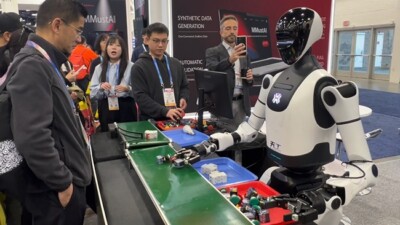
The CES 2026 agreement centers on an optical-electrical E/E platform using high-speed in-vehicle optical links to support scalable, zonal vehicle systems.
Autolink announced a strategic partnership with ReinOCS at CES 2026. The two companies signed a long-term cooperation agreement and confirmed that Autolink’s Deep Fusion EEA—an optical-electrical integrated E/E architecture unveiled globally for the first time—will serve as the technical foundation for joint system-level solutions for intelligent vehicles.
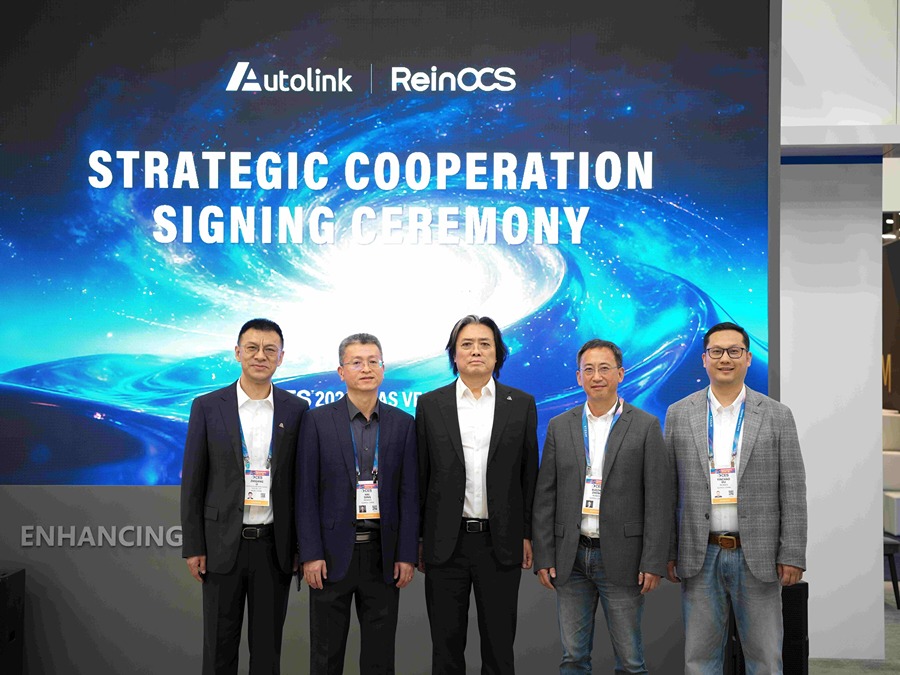
High-speed optical connectivity powers Deep Fusion EEA
Deep Fusion EEA (Electronic/Electrical Architecture) is Autolink’s next-generation unified computing and communication platform designed for future intelligent vehicles. The architecture integrates centralized computing, zonal control, and a high-bandwidth optical backbone into a single system, enabling millisecond-level coordination across perception, decision-making, and vehicle control.
Within the Deep Fusion EEA framework, the in-vehicle optical communication solution is provided by ReinOCS, demonstrating advanced system-level capabilities:
- Full-scenario adaptability
Supports lossless 8K@60Hz ultra-high-definition video transmission, meeting the data exchange requirements of multi-display intelligent cockpits and high-resolution autonomous driving sensors such as LiDAR and cameras. Transmission distances of up to 100 meters enable connectivity across multiple vehicle zones. - Extreme environmental robustness
Designed with lightweight construction and strong electromagnetic interference (EMI) immunity, the system operates reliably across automotive-grade temperature ranges from –40°C to 85°C, addressing signal attenuation challenges common in traditional copper-based transmission under complex vehicle environments. - Specialized optical and mechanical designs
Both the modules and cabling are engineered to withstand high-acceleration shocks and continuous full-spectrum vibration in automotive environments, fully meeting the reliability standards for in-vehicle harnesses and interconnects. Even under demanding operating conditions—such as frequent vehicle start-stop cycles and rough road surfaces—the solution ensures stable, continuous data transmission. - Architecture-level scalability
Featuring a modular interface design, the optical communication system seamlessly supports future multi-sensor fusion requirements for higher levels of automated driving (L4 and above). This enables OEMs to achieve “hardware-upgradable, software-evolvable” architectures while significantly reducing long-term E/E system upgrade costs.
Strategic partnership to advance optical-electrical convergence
Under the agreement, Autolink and ReinOCS will collaborate across three key areas: joint development of next-generation in-vehicle optical transmission protocols to further improve bandwidth and energy efficiency; delivery of integrated solutions combining optical connectivity, intelligent cockpit systems, and automated driving platforms; and joint efforts to advance industry standards for automotive optical communication, accelerating large-scale adoption across the sector.
Industry impact
As intelligent vehicles continue to move toward centralized architectures with exponential data growth, traditional copper-based networks are increasingly constrained. The optical-electrical integrated E/E approach jointly advanced by Autolink and ReinOCS addresses this challenge at the system level, supporting the industry’s transition from distributed electronics to centralized, software-defined vehicle platforms. Multiple OEM representatives at CES noted that such architectures could significantly shorten development cycles and lower deployment costs for advanced intelligent vehicles, positioning optical connectivity as a key enabler over the next three to five years.
For more information, visit en.auto-link.com.cn.