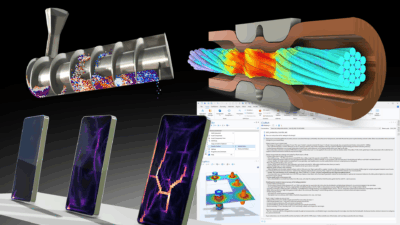
At the 2025 Comsol Conference Boston, engineers saw simulations of low-frequency electromagnetics and how circuits generate heat.
This article was originally published on EE World Online on October 16, 2025.
Comsol, the developer of multiphysics simulation software, held its annual Boston conference from October 8-10, 2025. While Comsol Multiphysics can perform many simulations, such as mechanical, structural, and chemical, we’ll focus on electromagnetic use cases.
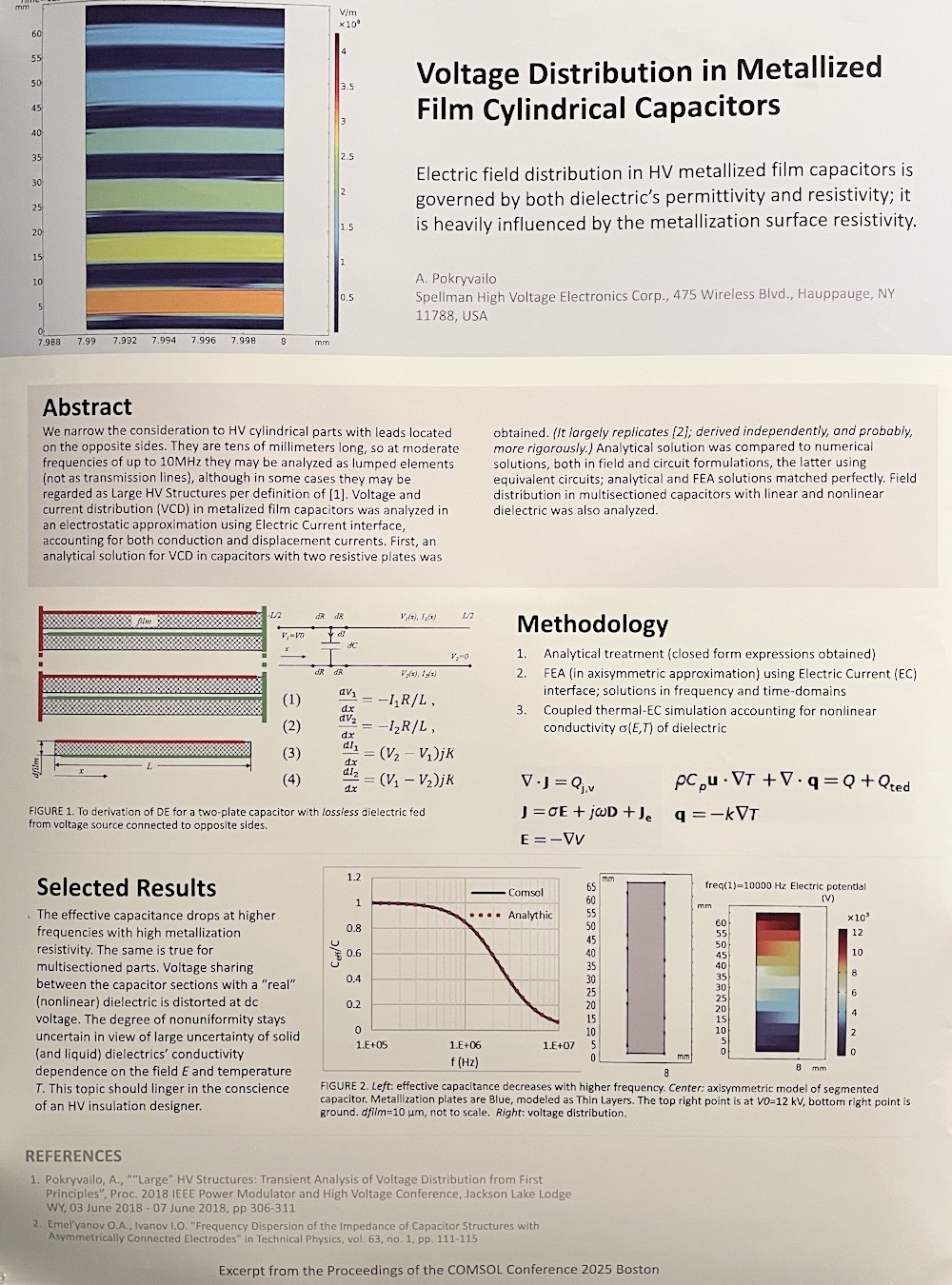
Comsol announced Multiphysics 6.4 through a series of sessions, each aimed at several uses across the engineering spectrum, and thus different users. The conference included exhibits from Comsol partner companies, which provide hardware, software, and consulting that expand the software’s capabilities. Attendees could see posters of Comsol use cases that appeared at conference sessions. The poster pictured below describes “Voltage Distribution in Metallized Cylindrical Film Capacitors.”
Comsol Multiphysics uses software modules that users install to perform simulations. One session covered low-frequency electromagnetics presented by Anslem Knobloch. The picture and video below provide an overview of use cases demonstrated at the conference. In the 1-hour session, Knobloch demonstrated simulations that covered:
- Capacitive touch screens and how they interact with a stylus pen. The model can analyze the capacitance at different locations in the grid, showing the position of the stylus tip.
- Electric fields generated from high-voltage power transmission lines.
- Insulated gate bipolar transistor (IGBT) modules in a circuit assembly capable of 1.8 kA at 1.2 kV. The simulation showed the current at any point in the IGBT module, how current affects heating at the interconnects and in the bus bar, and how the IGBT module becomes a heat source.
- Twisted cable modeling.
- Type 5 Litz Wire, showing how different twists improve performance levels and affect heating as frequency increases.
- Three-phase power transformers, where modeling shows how magnetorestriction can produce humming. In this model, you could see how transformer structure affects performance. This simulation required an analysis of structural mechanics and electromagnetic effects, including how a case affects performance.
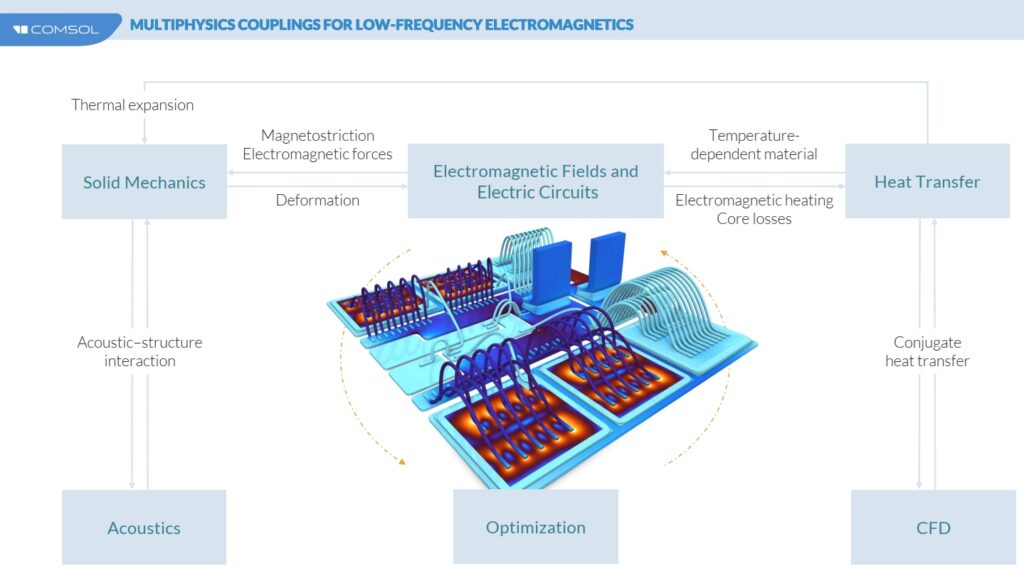
This three-minute video summarizes Knobloch’s presentation:
Following Knobloch’s session, I attended an invited talk given by an engineer at Advanced Magnetic Labs that covered wireless charging design. This talk covered modeling of 15 W and 50 W Qi chargers. By simulating leakage flux, engineers could optimize power transfer and efficiency. The simulation lets engineers study flux density, self-inductance, and mutual inductance, among other parameters.