It’s an AI play with $2 billion to boot. That plus the latest release of Comsol Multiphysics, a new AI simulation startup and more software news on today’s Engineering Paper.

(Thumbnail image: Nvidia CEO Jensen Huang (left) and Synopsys CEO Sassine Ghazi (right) delivering a joint press conference announcing the new strategic partnership.)
You’re reading Engineering Paper, and here’s the latest design and simulation software news.
Nvidia and Synopsys have announced a new strategic partnership that aims to tighten the bond between Nvidia’s computing hardware and Synopsys’ engineering software. As any good strategic partner would, Nvidia has also invested $2 billion in Synopsys common stock.
Naturally, AI is a big part of the new partnership. Nvidia and Synopsys will integrate their respective agentic AI technologies, including Synopsys AgentEngineer, Nvidia NIM microservices, Nvidia NeMo Agent Toolkit and Nvidia Nemotron. Synopsys will further tap into Nvidia’s CUDA-X AI libraries to optimize its simulation software for GPU computing.
The non-exclusive partnership will also include a collaboration on digital twin technologies, a focus on cloud solutions and joint go-to-market initiatives.
“Our partnership with Synopsys harnesses the power of Nvidia accelerated computing and AI to reimagine engineering and design — empowering engineers to invent the extraordinary products that will shape our future,” said Nvidia CEO Jensen Huang in the joint press release.
Synopsys CEO Sassine Ghazi filled out the same mad lib with slightly different words: “Together we will re-engineer engineering and empower innovators everywhere to more efficiently realize their innovations.”
Comsol releases Multiphysics version 6.4
Comsol has released the latest update to its simulation platform, Comsol Multiphysics version 6.4. It comes with new features, expanded capabilities, and major performance improvements, according to Comsol.
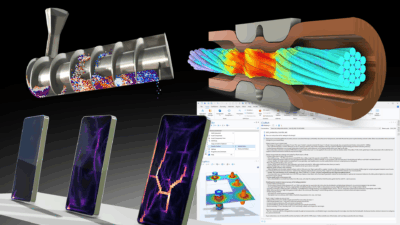
Among the version 6.4 updates is GPU support for all physics via Nvidia’s cuDSS direct sparse solver library, which Comsol says can provide substantial speedups compared to CPU-based solvers. The new release also supports multi-GPU acceleration for acoustics simulations, another potential speedup.
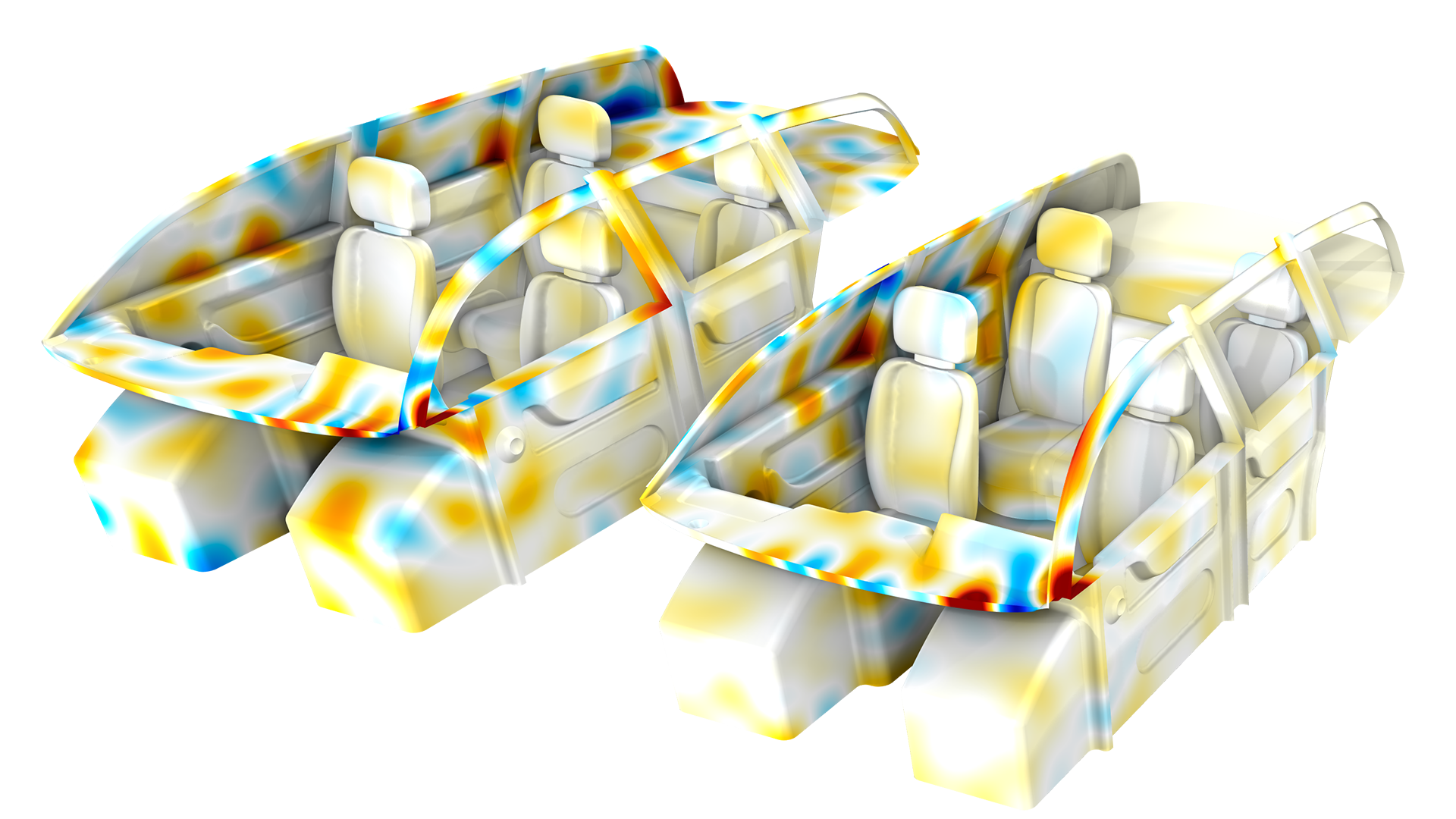
Another release highlight is the new Granular Flow Module, which uses the discrete element method to simulate grain and powder systems being mixed or conveyed.
Comsol Multiphysics 6.4 users will also have access to AI-assisted simulation through a chatbot window that now supports connections to OpenAI API-compatible LLMs including GPT-5, DeepSeek, Google Gemini, Anthropic Claude, and more. Comsol says this will enable model-aware assistance that leverages active simulation information along with Comsol documentation.
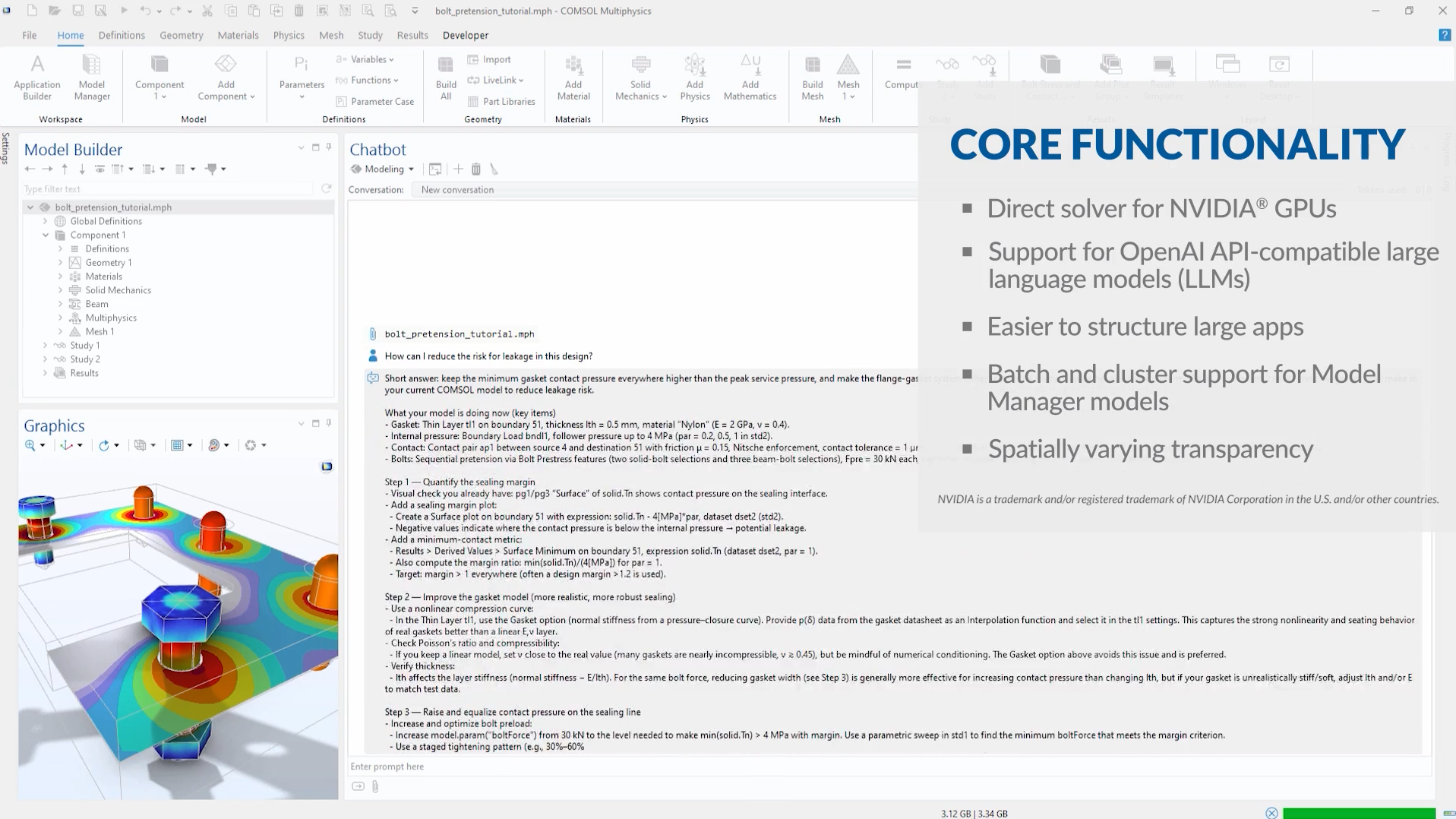
For a full list of the Multiphysics 6.4 updates, including geometry and meshing enhancements, new capabilities in the Application Builder, and new visualization features, check out the Comsol Multiphysics 6.4 release highlights.
Veni, Vidi, Vinci
A startup called Vinci has emerged from stealth with an AI solution for semiconductor thermal simulation. The company announced $46 million in total funding and boasts that its physics-based AI software runs up to 1000x faster than conventional FEA tools.
Vinci says that its AI foundation model can currently simulate steady-state conduction, transient conduction, and steady-state thermoelasticity. According to Vinci, the AI software does not require meshing, does not hallucinate (the press release boldly claims “guaranteed accuracy”), and does not require nor train on proprietary customer data.
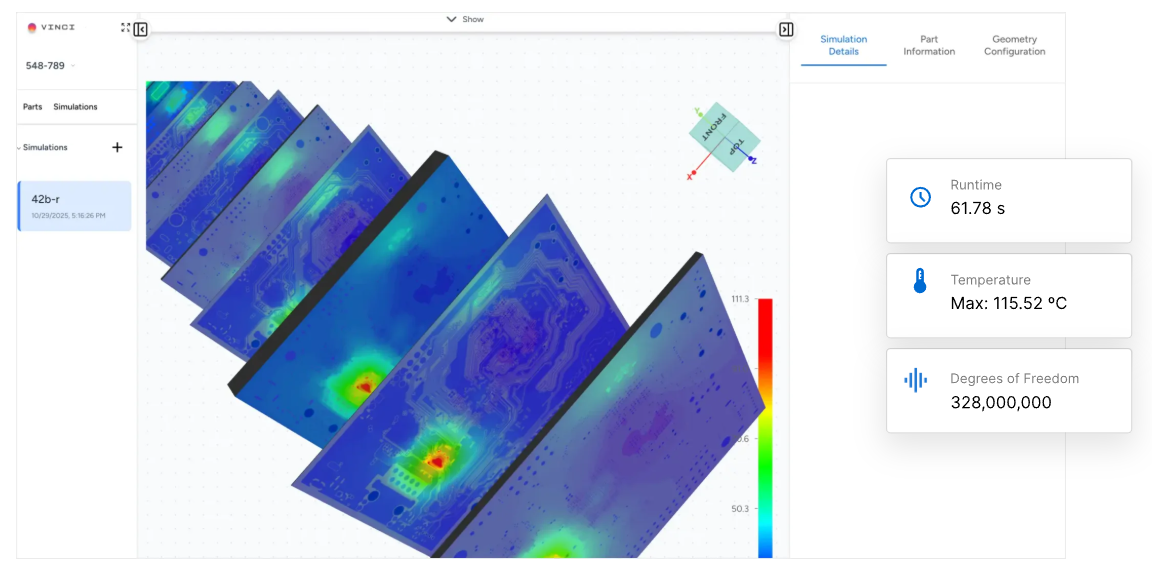
“Vinci empowers engineers to simulate how designs will perform in seconds instead of days, at a fraction of the compute cost,” said Vinci CEO Hardik Kabaria in the company’s press release. “On next-generation geometries that conventional tools must simplify, such as nanometer-scale components on centimeter-scale dies, Vinci maintains full-fidelity accuracy.”
Vinci says its software is already deployed at three leading semiconductor manufacturers, and has been successfully benchmarked at several more. The startup is currently offering scheduled demos through its website.
Quick hits
- In more Synopsys news, developer JuliaHub has announced that its Dyad simulation platform will be integrated with Ansys TwinAI (Ansys is now owned by Synopsys) to “combine physics-based simulation with adaptive AI models, allowing engineers to create ‘hybrid digital twins’ that are both predictive and grounded in physical laws.”
- CAM developer Ency has released Ency 2.5, an update with “130 changes focused on smoother day-to-day workflows and increased stability across machining, simulation, and platform features.”
- Artec 3D has launched Artec Studio Lite, a lower cost version of its Artec Studio software for 3D data capture and processing. Studio Lite does not support 3D scanning, but Artec says it will offer the core processing features of the full version with a simplified workflow for photos and videos. In particular, it provides AI photogrammetry, which Artec says can deliver accurate 3D models with very few photos. Artec Studio Lite is available in two tiers: Business ($960 per year) and Individual ($480 per year). The full version, Artec Studio Pro, costs $1,700 per year.
One last link
If you made it this far, you must like engineering news roundups. So here’s another one for you, from Engineering.com senior editor Ian Wright: 3D printing research roundup: Fast-curing concrete, blood vessels on a chip, micro delta robots and more!
Got news, tips, comments, or complaints? Send them my way: [email protected].